
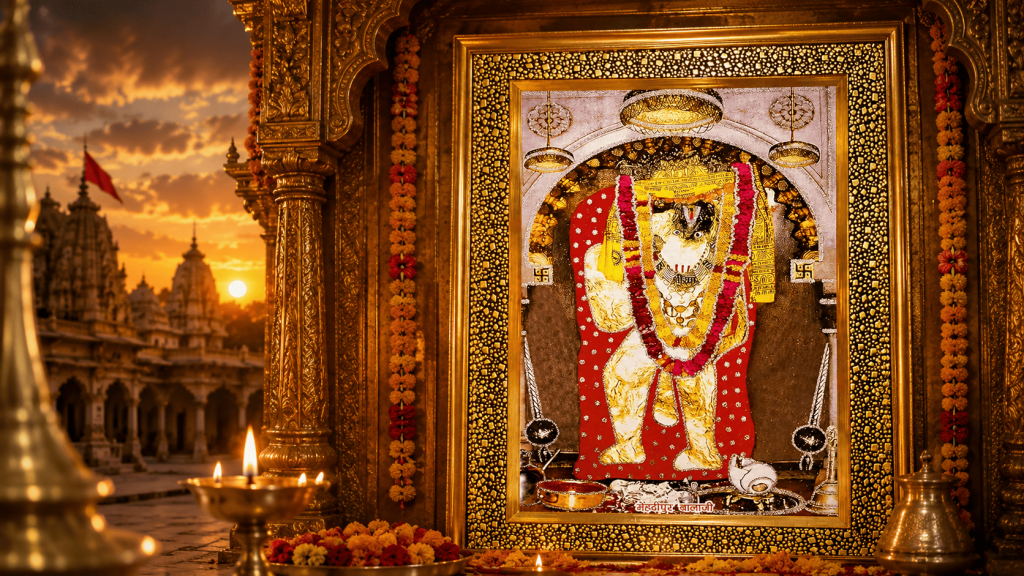
Mehandipur Balaji Temple History: The Complete Story, Legends & Spiritual Significance
2 July 2026 by admin

Mehandipur Balaji Temple History: The Complete Story, Legends & Spiritual Significance
Introduction
Mehandipur Balaji Temple is one of the most revered and spiritually significant Hanuman temples in India. Located in the Dausa district of Rajasthan, this ancient temple attracts millions of devotees every year who seek the blessings of Lord Hanuman (Balaji Maharaj) for protection, strength, peace, and relief from negative energies.
Unlike many other Hanuman temples, Mehandipur Balaji Temple is widely known for its unique rituals, centuries-old traditions, and deep spiritual beliefs. Devotees from across India and abroad visit this sacred shrine with immense faith, believing that Lord Hanuman removes obstacles, protects His devotees from evil influences, and blesses them with courage and prosperity.
The temple is also famous for the presence of Pretraj Sarkar and Bhairav Baba, making it one of the most distinctive pilgrimage sites in Hinduism.
In this article, we’ll explore the history of Mehandipur Balaji Temple, its ancient legends, spiritual significance, and why this holy place continues to inspire unwavering devotion among millions of believers.
About Mehandipur Balaji Temple
Mehandipur Balaji Temple is situated in the small town of Mehandipur, located on the border of Dausa and Karauli districts in Rajasthan.
The temple is dedicated to Lord Hanuman, who is worshipped here as Balaji Maharaj.
Unlike traditional Hanuman temples where devotees primarily seek blessings for strength and success, Mehandipur Balaji is particularly famous for prayers related to protection from negative energies and spiritual well-being. Visitors come here with deep faith, seeking peace, courage, and divine guidance through the temple’s long-standing religious traditions.
Today, thousands of pilgrims visit the temple daily, while the number increases significantly on Tuesdays, Saturdays, Hanuman Jayanti, and other auspicious occasions.
Why Is Mehandipur Balaji Temple So Famous?
Several factors contribute to the temple’s immense popularity.
Ancient Self-Manifested Balaji Idol
The idol of Mehandipur Balaji is believed by devotees to be Swayambhu (self-manifested) rather than carved by human hands.
Strong Spiritual Faith
For generations, devotees have believed that sincere prayers offered here help remove obstacles, fear, and negative influences from life.
Presence of Three Divine Powers
The temple is unique because it houses:
- Balaji Maharaj (Lord Hanuman)
- Pretraj Sarkar
- Bhairav Baba (Kotwal)
Together, these three divine forms symbolize protection, justice, and spiritual balance according to temple traditions.
Centuries of Devotion
Thousands of devotees share personal experiences of answered prayers, which has strengthened the temple’s reputation over generations.
The History of Mehandipur Balaji Temple
The exact construction date of Mehandipur Balaji Temple is not historically documented. However, according to local traditions and temple beliefs, the shrine is believed to have existed for several centuries. Furthermore, the temple’s long-standing religious significance has made it an important pilgrimage destination.
According to temple tradition, the idol of Balaji was not installed by any king or sculptor. Instead, it is believed to have appeared naturally on a mountain rock. Furthermore, devotees regard this divine appearance as a manifestation of Lord Hanuman and an important part of the temple’s spiritual significance.
Over time, the divine presence attracted saints and devotees who began worshipping the sacred site.
Gradually, a temple developed around the self-manifested idol, becoming one of India’s most respected Hanuman pilgrimage destinations.
Although historians cannot verify every traditional account, nevertheless, the temple’s religious importance has remained deeply rooted in the faith of devotees for hundreds of years. Over time, this enduring faith has further strengthened the temple’s spiritual significance.
The Divine Legend Behind Mehandipur Balaji
One of the most well-known legends associated with Mehandipur Balaji tells the story of a saint who experienced a divine vision.
According to temple tradition, while a saint was meditating in the forests near Mehandipur, he witnessed a remarkable spiritual sight. As a result, this experience is believed to have played an important role in the spiritual history of the temple.
He saw thousands of celestial beings moving toward a mountain where a brilliant divine light was shining.
Curious, the saint followed the divine procession.
There he witnessed Lord Hanuman appearing in His divine form.
Balaji instructed the saint to begin worship at that sacred place and assured him that devotees visiting with faith would receive His blessings.
The next morning, when the saint returned to the site, he found the naturally manifested idol exactly where he had witnessed the divine vision. As a result, this discovery further strengthened the belief surrounding the temple’s divine origin.
From that day onward, worship began at the site.
As news of miraculous experiences spread, devotees from distant regions started visiting the temple.
As a result, over the centuries, Mehandipur Balaji gradually became one of the most important Hanuman temples in India. Moreover, its growing spiritual significance attracted devotees from different parts of the country.
The Three Divine Deities of Mehandipur Balaji
One of the temple’s most distinctive features is the worship of three divine forms.
1. Balaji Maharaj
The central deity is Lord Hanuman.
Devotees offer prayers seeking:
- Protection
- Courage
- Good health
- Prosperity
- Success
- Peace of mind
Balaji is regarded as the supreme protector of devotees.
2. Pretraj Sarkar
Pretraj Sarkar is revered as the divine administrator of justice according to temple tradition.
Devotees offer prayers here while seeking fairness, truth, and relief from suffering.
Temple rituals connected with Pretraj Sarkar reflect the belief that righteousness ultimately prevails.
3. Bhairav Baba (Kotwal)
Bhairav Baba is worshipped as the guardian of the temple.
According to Hindu tradition, Bhairav protects sacred places and devotees from harmful influences.
Many pilgrims visit all three shrines during their temple visit.
Spiritual Significance of Mehandipur Balaji Temple
For devotees, Mehandipur Balaji Temple is not merely a place of worship—it is a sacred center of faith and spiritual surrender.
People visit the temple with prayers for:
- Inner peace
- Courage
- Protection
- Prosperity
- Good health
- Relief from life’s challenges
- Spiritual strength
The temple inspires devotees to strengthen their faith, maintain discipline, and cultivate devotion toward Lord Hanuman.
Many visitors describe a profound sense of peace and renewed hope after offering prayers here.

The Role of Hanuman Ji in Hinduism
Lord Hanuman occupies a unique place in Hindu tradition.
He is revered as:
- The greatest devotee of Lord Rama
- A symbol of unwavering faith
- The embodiment of strength and humility
- The protector of righteousness
- The remover of fear and obstacles
The Ramayana portrays Hanuman as the ideal servant of Dharma, whose devotion and courage continue to inspire generations.
These qualities are central to the worship of Balaji at Mehandipur.
Why Millions Visit Mehandipur Balaji Every Year
Every year, devotees from across India visit Mehandipur Balaji Temple because of their deep faith in Lord Hanuman.
The temple attracts pilgrims who come to:
- Offer prayers to Balaji Maharaj.
- Participate in temple rituals.
- Seek blessings for their families.
- Express gratitude for answered prayers.
- Experience the spiritual atmosphere of the temple.
- Strengthen their devotion and faith.
Special occasions such as Hanuman Jayanti, Tuesdays, and Saturdays witness exceptionally large gatherings of devotees.
The Timeless Message of Mehandipur Balaji
Beyond its history and legends, Mehandipur Balaji conveys a profound spiritual message.
The temple reminds devotees that true strength comes from:
- Faith in God
- Courage during adversity
- Devotion over fear
- Truth over falsehood
- Humility over ego
- Service to humanity
Lord Hanuman’s life demonstrates that unwavering devotion and selfless service are among the highest virtues in Hindu philosophy.
Unique Rituals of Mehandipur Balaji Temple
One of the most distinctive aspects of Mehandipur Balaji Temple is its traditional worship practices. These rituals have been followed for generations and are performed according to the temple’s customs and religious beliefs.
Every day, thousands of devotees participate in prayers, offer prasad, attend the aarti, and seek the blessings of Balaji Maharaj, Pretraj Sarkar, and Bhairav Baba. Many visitors come with deep faith, believing that sincere devotion at the temple brings peace, strength, and spiritual comfort.
The temple atmosphere is filled with continuous chanting of Hanuman Chalisa, Sunderkand, and other devotional hymns dedicated to Lord Hanuman.
The Three Famous Offerings (Prasad)
One of the unique traditions at Mehandipur Balaji Temple is offering three different types of prasad.
1. Arzi
Arzi is offered by devotees as a prayer to Lord Hanuman.
People offer Arzi while praying for:
- Good health
- Family happiness
- Protection
- Removal of obstacles
- Career success
- Spiritual growth
The offering symbolizes complete surrender to Balaji Maharaj.
2. Darkhast
Darkhast represents a humble request made before the divine.
Devotees offer it with faith, believing that Lord Hanuman listens to sincere prayers and guides devotees toward peace and righteousness.
3. Sawa Mani
Sawa Mani is offered after devotees feel their prayers have been answered.
It is considered an expression of gratitude toward Balaji Maharaj.
Many families distribute the prasad among devotees as an act of devotion and charity.
Daily Aarti at Mehandipur Balaji Temple
The temple conducts daily aarti with great devotion.
The atmosphere becomes spiritually uplifting as bells ring, devotional songs fill the temple, and hundreds of devotees gather to offer prayers.
The morning and evening aartis are especially popular among pilgrims.
Visitors often arrive early to experience the divine atmosphere and participate peacefully in the worship.
Temple Rules Every Devotee Should Follow
The temple follows several traditional customs that visitors are encouraged to respect.
Maintain Respectful Conduct
The temple is a sacred place of worship. Devotees should maintain silence, discipline, and respect while inside the temple premises.
Dress Modestly
Simple and traditional clothing is generally preferred while visiting the temple.
Follow Temple Instructions
Visitors should follow the guidance provided by temple authorities regarding darshan, prasad, and queue management.
Avoid Littering
Help maintain the cleanliness of the temple by disposing of waste responsibly.
Respect Local Customs
Temple traditions have been followed for centuries. Devotees are encouraged to respect these customs regardless of their personal background.
Things to Keep in Mind While Visiting
A few practical tips can make your pilgrimage smoother.
- Visit early in the morning to avoid long queues.
- Carry drinking water, especially during summer.
- Wear comfortable footwear, as you may need to walk.
- Keep your belongings secure in crowded areas.
- Follow instructions from temple volunteers.
- Be patient during festivals and weekends, as large crowds are common.
Best Time to Visit Mehandipur Balaji Temple
The temple remains open throughout the year.
However, the most pleasant months for travel are:
- October
- November
- December
- January
- February
- March
The weather during these months is generally comfortable for darshan.
Festivals Celebrated at Mehandipur Balaji
Several Hindu festivals are celebrated with immense devotion.
Hanuman Jayanti
This is one of the biggest festivals celebrated at the temple.
Thousands of devotees gather to perform special prayers and participate in grand celebrations.
Tuesdays and Saturdays
These two days are considered especially auspicious for worshipping Lord Hanuman.
The temple receives a very large number of pilgrims every week.
Ram Navami
Devotees also visit the temple during Ram Navami because of Lord Hanuman’s eternal devotion to Lord Shri Ram.
Diwali and Other Hindu Festivals
The temple is beautifully decorated, and special prayers are conducted during major Hindu festivals.
How to Reach Mehandipur Balaji Temple
By Road
Mehandipur Balaji Temple is also well connected by road from major cities such as Jaipur, Delhi, Agra, Bharatpur, Alwar, Dausa, and Karauli. In addition, regular Rajasthan Roadways (RSRTC) and private buses operate to Mehandipur. Moreover, taxis are also easily available, making road travel a convenient option for devotees.
The nearest bus depot to the temple is Central Bus Stand, Balaji Mandir, located just a short walking distance from the temple, making it the most convenient drop-off point for pilgrims.
Approximate Road Distances:
- Jaipur – 105 km (2.5–3 hours)
- Delhi – 260 km (5–6 hours)
- Agra – 145 km (3–4 hours)
- Dausa – 45 km (1 hour)
- Bharatpur – 95 km (2 hours)
- Alwar – 95 km (2–2.5 hours)
By Train
The nearest railway station to Mehandipur Balaji Temple is Bandikui Junction (BKI), located approximately 34–36 km from the temple. It is well connected to major cities like Delhi, Jaipur, Agra, Kota, and Alwar. From Bandikui Junction, visitors can hire taxis, shared jeeps, or local buses to reach the temple in about 45–60 minutes. (YatraDham)
Another nearby railway station is:
- Dausa Railway Station – approximately 45 km from the temple. It is also connected to several major cities. However, Bandikui Junction is generally considered the more convenient option for pilgrims. Therefore, many devotees prefer this railway station when planning their journey to Mehandipur Balaji Temple.
By Air
The nearest airport is Jaipur International Airport, situated approximately 100–110 km from Mehandipur Balaji Temple. Furthermore, it offers regular domestic flights from major Indian cities such as Delhi, Mumbai, Bengaluru, Hyderabad, Kolkata, Chennai, and Ahmedabad, as well as select international connections. From the airport, visitors can hire a taxi or travel to Jaipur Bus Stand to continue their journey by bus to Mehandipur Balaji. (rome2rio.com)
Nearby Places to Visit
Many pilgrims combine their visit with nearby spiritual destinations.
Popular places include:
- Chand Baori (Abhaneri)
- Bhandarej
- Kaila Devi Temple
- Jaipur
- Karauli
- Ranthambore (for wildlife enthusiasts)
Why Devotees Have Unwavering Faith in Mehandipur Balaji
The greatest strength of Mehandipur Balaji Temple lies in the faith of its devotees.
For generations, families have visited this sacred shrine to express gratitude, seek guidance, and pray for courage during difficult times.
Many devotees believe that worshipping Balaji Maharaj brings:
- Inner peace
- Confidence
- Mental strength
- Positive thinking
- Protection
- Family harmony
- Spiritual satisfaction
Regardless of individual experiences, the temple remains a powerful symbol of devotion and hope.
Spiritual Lessons from Mehandipur Balaji
The temple teaches several timeless values.
Faith
Trust in God during both happiness and hardship.
Devotion
True devotion requires sincerity rather than material offerings.
Discipline
A disciplined life strengthens both character and spirituality.
Service
Helping others is one of the highest forms of worship.
Courage
Lord Hanuman inspires devotees to face challenges fearlessly.
Conclusion
Mehandipur Balaji Temple is much more than a famous pilgrimage destination—it is a place where faith, devotion, tradition, and spirituality come together.
The temple’s rich history, ancient legends, and centuries-old worship practices continue to attract millions of devotees from across India and around the world. Whether you visit to offer prayers, seek blessings, or simply experience the temple’s spiritual atmosphere, Mehandipur Balaji leaves a lasting impression on every pilgrim.
The story of Balaji Maharaj, along with the worship of Pretraj Sarkar and Bhairav Baba, reflects the enduring values of courage, righteousness, and devotion. Above all, the temple reminds us of Lord Hanuman’s unwavering service to Lord Rama and inspires us to cultivate faith, humility, and inner strength in our own lives.
May Balaji Maharaj bless you and your family with peace, protection, prosperity, and unwavering devotion.
॥ Jai Shri Balaji Maharaj ॥
॥ Jai Hanuman ॥
Frequently Asked Questions (FAQs)
1. Why is Mehandipur Balaji Temple famous?
Mehandipur Balaji Temple is famous for its centuries-old Hanuman worship traditions, the self-manifested idol of Balaji Maharaj, and the presence of Pretraj Sarkar and Bhairav Baba.
2. Where is Mehandipur Balaji Temple located?
The temple is located in Mehandipur, in Rajasthan’s Dausa district, near the border with Karauli district.
3. Who are the three main deities worshipped in the temple?
The temple is dedicated to Balaji Maharaj (Lord Hanuman), Pretraj Sarkar, and Bhairav Baba.
4. What is Sawa Mani at Mehandipur Balaji Temple?
Sawa Mani is a traditional offering made by devotees as an expression of gratitude after prayers are fulfilled.
5. Which day is best to visit Mehandipur Balaji Temple?
Tuesdays and Saturdays are considered especially auspicious for Lord Hanuman worship, though they are also the busiest days.
6. What is the best time to visit Mehandipur Balaji Temple?
The winter months from October to March offer pleasant weather for darshan and travel.
7. Can anyone visit Mehandipur Balaji Temple?
Yes. People of all ages and backgrounds are welcome to visit while respecting the temple’s customs and traditions.
8. Is photography allowed inside the temple?
Photography rules may vary in different areas of the temple. Visitors should follow the latest instructions issued by the temple authorities.
Note: If you enjoy learning about Hindu festivals and sacred pilgrimage sites, you may also like our guides on Salasar Balaji Temple, Haridwar, and the 12 Jyotirlingas of India.