
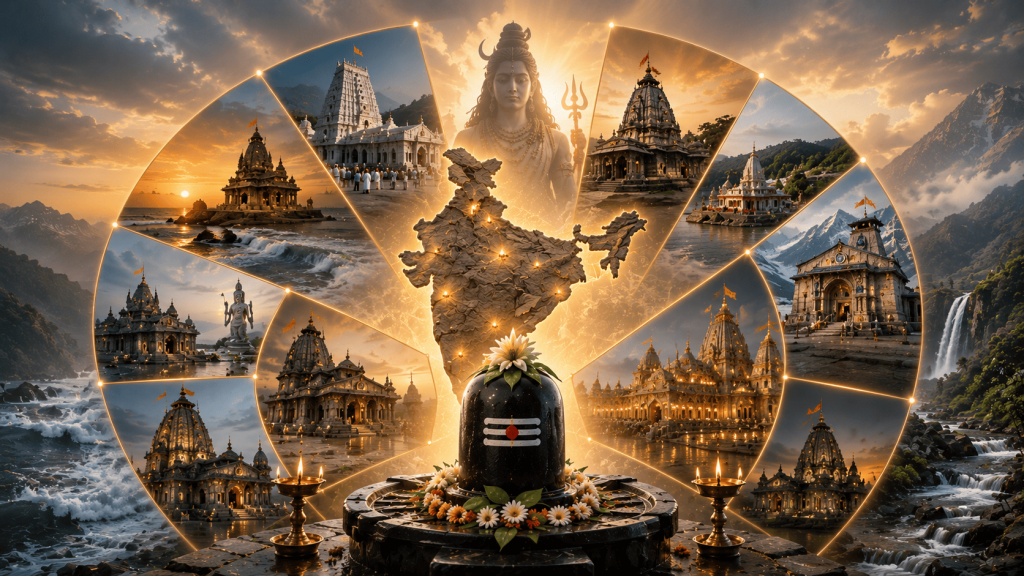
12 Jyotirlingas of India – History, Significance & Complete Guide
21 July 2026 by admin

12 Jyotirlingas of India – History, Significance & Complete Guide
India has always been the land of devotion. Every corner of the country carries stories of gods, saints, sages, and sacred rivers. Among all the pilgrimage destinations dedicated to Lord Shiva, the 12 Jyotirlingas of India hold the highest place. Millions of devotees travel across the country every year to seek the blessings of these divine shrines.
A Jyotirlinga is not just a temple. It represents the eternal form of Lord Shiva as an infinite pillar of divine light. Hindu scriptures describe these sacred places as locations where Shiva revealed Himself in the form of pure cosmic energy. Each Jyotirlinga carries a unique history, spiritual significance, and powerful legend.
The journey to all 12 Jyotirlingas of India is known as the Jyotirlinga Yatra. Many devotees believe that completing this pilgrimage with faith and devotion brings peace, removes negative karma, and leads the soul closer to liberation.
This guide explores every Jyotirlinga in detail. You will learn about its history, mythology, architecture, rituals, festivals, travel information, and spiritual importance. Every section draws inspiration from traditional Hindu scriptures, temple traditions, and historical records.
What Is a Jyotirlinga?
The word Jyotirlinga comes from two Sanskrit words:
- Jyoti means divine light.
- Linga represents the symbol of Lord Shiva.
A Jyotirlinga is the radiant form of Lord Shiva that appeared as an endless column of light. Unlike ordinary Shiva Lingas installed by humans, devotees believe these sacred Lingas manifested through Shiva’s divine power.
The Shiva Purana, one of the most respected scriptures dedicated to Lord Shiva, describes the origin of the 12 Jyotirlingas of India Jyotirlingas.
The Story Behind the Origin of Jyotirlingas
According to the Shiva Purana, Lord Brahma and Lord Vishnu once entered into a dispute over who was supreme. Their argument continued until a gigantic pillar of light suddenly appeared before them.
The pillar stretched beyond the heavens and deep below the earth. Neither its beginning nor its end could be seen.
Lord Vishnu transformed into Varaha, the divine boar, and travelled downward to locate the base.
Lord Brahma took the form of a swan and flew upward to find the top.
Both searched for countless years but failed.
Lord Vishnu accepted defeat and admitted that the pillar had no beginning or end.
Lord Brahma, however, falsely claimed that he had reached the top. He even brought the Ketaki flower as false evidence.
Lord Shiva then emerged from the endless pillar of light. He praised Vishnu for speaking the truth and punished Brahma for his dishonesty. Shiva declared that Brahma would rarely receive worship on Earth, while the Ketaki flower would no longer be offered during Shiva worship.
This infinite pillar of divine light became known as the Jyotirlinga.
The twelve Jyotirlingas across India represent twelve sacred places where this divine light continues to bless devotees.
Spiritual Importance of the Jyotirlingas
Hindu scriptures describe Lord Shiva as the destroyer of ignorance and the source of supreme consciousness.
All 12 Jyotirlinga of India symbolizes one aspect of Shiva’s infinite nature.
Devotees believe that visiting these shrines helps in:
- Purifying the mind
- Reducing negative karma
- Strengthening devotion
- Attaining inner peace
- Seeking blessings for health
- Overcoming fear
- Receiving protection from obstacles
- Progressing toward Moksha
Many pilgrims perform Abhishekam, chant the Maha Mrityunjaya Mantra, and recite the Shiva Panchakshari Mantra (Om Namah Shivaya) during their visit.
List of the Twelve Jyotirlingas
| Jyotirlinga | State |
|---|---|
| Somnath | Gujarat |
| Mallikarjuna | Andhra Pradesh |
| Mahakaleshwar | Madhya Pradesh |
| Omkareshwar | Madhya Pradesh |
| Kedarnath | Uttarakhand |
| Bhimashankar | Maharashtra |
| Kashi Vishwanath | Uttar Pradesh |
| Trimbakeshwar | Maharashtra |
| Vaidyanath | Jharkhand (traditional list followed by many devotees; the location is debated in some traditions) |
| Nageshwar | Gujarat |
| Rameshwaram | Tamil Nadu |
| Grishneshwar | Maharashtra |

1. Somnath Jyotirlinga
Location
Prabhas Patan, Gir Somnath District, Gujarat
Why Is Somnath So Important?
Somnath is one of the most famous Shiva temples in India traditionally regarded as the first among the 12 Jyotirlingas of India.
The temple stands near the Arabian Sea. Waves continuously touch the sacred shoreline, creating a peaceful atmosphere. Devotees believe Shiva’s presence has protected this land for thousands of years.
The name Somnath means “Lord of the Moon.”
Legend of Somnath Jyotirlinga
The legend begins with Chandra Dev, the Moon God.
Daksha Prajapati married his twenty-seven daughters to Chandra. These daughters represent the twenty-seven Nakshatras in Hindu astronomy.
Chandra loved only Rohini and spent most of his time with her.
The remaining wives complained to their father.
Daksha warned Chandra several times.
Chandra ignored every warning.
Daksha became angry and cursed Chandra.
The curse caused the Moon to lose its brightness day after day.
Darkness spread across the heavens.
The gods became worried.
They advised Chandra to perform severe penance for Lord Shiva.
Chandra reached the sacred land of Prabhas and worshipped Shiva with complete devotion.
Pleased by his penance, Lord Shiva appeared before him.
Shiva could not completely remove Daksha’s curse because the curse came from a powerful sage. Instead, Shiva modified its effect.
The Moon would decrease for fifteen days and regain its brightness during the next fifteen days.
This cycle became the waxing and waning phases of the Moon.
Lord Shiva also agreed to remain forever at this sacred place as Somnath.
Historical Background
Somnath has one of the longest recorded histories among all 12 Jyotirlingas of India.
Ancient texts mention its existence thousands of years ago.
Several dynasties rebuilt the temple after repeated invasions.
Historical records describe attacks by Mahmud of Ghazni in 1025 CE.
The temple faced destruction several times during medieval history.
Each generation rebuilt it with renewed devotion.
India reconstructed the present temple after independence.
The reconstruction began under the guidance of Sardar Vallabhbhai Patel.
The current temple was completed in the Chalukya architectural style.
Architecture
The temple follows the Kailash Mahameru Prasad Style.
Important features include:
- Magnificent stone carvings
- Tall shikhara rising above the coastline
- Massive entrance gateway
- Beautiful Sabha Mandap
- Sea-facing location
- Sacred Garbhagriha
- Intricately carved pillars
One remarkable feature is the Baan Stambh, an arrow pillar facing the sea. Temple tradition states that no land exists directly south of this point until Antarctica.
Spiritual Significance
Devotees visit Somnath to seek:
- Relief from mental stress
- Emotional balance
- Peace in family life
- Success in personal goals
- Blessings related to the Moon in Vedic astrology
Many devotees also perform Rudrabhishek here.
Major Festivals
- Maha Shivaratri
- Kartik Purnima
- Shravan Month Celebrations
- Somvati Amavasya
Best Time to Visit
October to March offers pleasant weather.
Shravan and Maha Shivaratri attract huge crowds.
Temple Timings
General Darshan:
6:00 AM – 10:00 PM
Timings may change during festivals.
Nearby Attractions
- Triveni Sangam
- Bhalka Tirth
- Dehotsarg Tirth
- Somnath Beach
- Prabhas Patan Museum

2. Mallikarjuna Jyotirlinga
Location
Srisailam, Andhra Pradesh
The temple stands on the beautiful Nallamala Hills, close to the Krishna River.
Why Is Mallikarjuna Unique?
Mallikarjuna is one of the few sacred places where devotees receive the blessings of both Lord Shiva and Goddess Parvati together.
The temple is also one of the 18 Maha Shakti Peethas, making it an important pilgrimage destination for both Shaivites and Shaktas.
Legend of Mallikarjuna
The story connects with Lord Ganesha and Lord Kartikeya.
One day, Shiva and Parvati decided to arrange the marriage of their sons.
They announced a challenge.
Whoever circled the world first would marry first.
Kartikeya immediately mounted his peacock and began travelling around the world.
Ganesha quietly walked around his parents three times.
He explained that parents represent the entire universe.
Shiva and Parvati appreciated his wisdom.
They declared Ganesha the winner.
Kartikeya felt disappointed.
He left Mount Kailash and settled on the hills of Srisailam.
Shiva and Parvati came to console their son.
They decided to remain at this sacred place forever.
Shiva became known as Mallikarjuna.
The name combines:
- Mallika (Parvati)
- Arjuna (Shiva)
Historical Importance
Several South Indian dynasties expanded the temple.
Major contributions came from:
- Satavahanas
- Chalukyas
- Kakatiyas
- Vijayanagara Empire
The temple has remained an important center of Shaiva worship for centuries.
Temple Architecture
The temple reflects classic Dravidian architecture.
Visitors admire:
- Massive entrance towers
- Stone carvings
- Decorative pillars
- Large temple courtyards
- Ancient inscriptions
- Sculptures depicting stories from Hindu mythology
Spiritual Significance
Devotees pray here for:
- Family harmony
- Marital happiness
- Prosperity
- Spiritual wisdom
- Liberation from worldly suffering
Many couples visit the temple to seek blessings for a peaceful married life.
Major Festivals
- Maha Shivaratri
- Brahmotsavam
- Ugadi
- Karthika Deepam
Best Time to Visit
October to February remains comfortable.
Shravan attracts thousands of pilgrims.
Temple Timings
Approximately:
4:30 AM – 10:00 PM
Special rituals follow separate schedules.
Nearby Attractions
- Srisailam Dam
- Pathala Ganga
- Akka Mahadevi Caves
- Srisailam Wildlife Sanctuary

3. Mahakaleshwar Jyotirlinga
Location
Ujjain, Madhya Pradesh
The temple stands near the holy Shipra River, one of India’s seven sacred rivers.
Why Is Mahakaleshwar Special?
Mahakaleshwar is the only south-facing Jyotirlinga (Dakshinamukhi) among the 12 Jyotirlingas of India. Hindu tradition considers this form especially powerful because it symbolizes Lord Shiva as the conqueror of death and time.
Another unique feature is the famous Bhasma Aarti, performed before sunrise. Traditionally, sacred ash forms an important part of this ritual, reflecting Shiva’s association with renunciation and the transient nature of life. Today, the ceremony follows temple regulations and established customs.
The Legend of Mahakaleshwar
Ancient traditions describe Ujjain as the prosperous city of King Chandrasena, a devoted worshipper of Lord Shiva. The king possessed a sacred gem believed to radiate divine energy.
A young boy named Shrikar once saw the king praying with deep devotion. Inspired by this sight, the child began worshipping Shiva with complete faith.
Around the same time, rival kings and the demon Dushan attacked Ujjain. Their aim was to conquer the city and destroy the worship of Lord Shiva.
The frightened citizens prayed for protection.
Lord Shiva appeared in a fierce form from the earth itself. His terrifying roar shook the battlefield. He destroyed Dushan and defeated the invading forces.
The people requested Shiva to remain in Ujjain forever.
Shiva accepted their prayer and manifested as Mahakaleshwar, the Great Lord of Time.
Historical Background
Mahakaleshwar has remained one of the most respected Shaivite temples for centuries.
Historical references appear in ancient Sanskrit literature and Puranic texts. The temple underwent damage during medieval invasions and later received major restoration under the Maratha rulers, especially during the eighteenth century.
The present structure reflects Maratha architectural influence while preserving the temple’s ancient spiritual identity.
Architecture
The temple combines traditional North Indian and Maratha architectural elements.
Notable features include:
- Multi-level temple complex
- Sacred underground Garbhagriha
- Tall shikhara
- Ornate mandapas
- Carved stone pillars
- Silver-plated doors around the sanctum
- Spacious courtyards for pilgrims
The Jyotirlinga is installed below ground level, a distinctive feature among the twelve Jyotirlingas.
Bhasma Aarti
The Bhasma Aarti is the temple’s most celebrated ritual.
It begins before sunrise and draws devotees from across India and abroad.
During the ceremony:
- Priests awaken the deity with traditional Vedic chants.
- The Linga receives ceremonial worship with sacred offerings.
- Sacred ash forms part of the ritual according to temple tradition.
- Bells, conch shells, and devotional hymns create a deeply spiritual atmosphere.
Because of the limited space, devotees usually need advance registration to attend the Bhasma Aarti.
Spiritual Significance
Devotees visit Mahakaleshwar to seek:
- Protection from fear
- Strength during difficult times
- Relief from negative influences
- Inner courage
- Spiritual growth
- Blessings for a long and meaningful life
Many believe that sincere worship at Mahakaleshwar helps devotees remember the eternal nature of the soul and the temporary nature of worldly existence.
Major Festivals
- Maha Shivaratri
- Shravan Month Celebrations
- Nag Panchami
- Kartik Festivals
- Harihar Milap
During the Simhastha Kumbh Mela, held in Ujjain every twelve years, the temple becomes one of the most visited pilgrimage sites in India.
Best Time to Visit
October to March offers pleasant weather for sightseeing and temple visits.
The month of Shravan and the Maha Shivaratri festival provide a deeply devotional experience, though visitor numbers remain very high.
Temple Timings
General Darshan:
4:00 AM – 11:00 PM
Timings may change on festival days and during special rituals.
Nearby Attractions
- Harsiddhi Temple
- Kal Bhairav Temple
- Ram Ghat
- Sandipani Ashram
- Mangalnath Temple
- Vedh Shala (Jantar Mantar of Ujjain)

4. Omkareshwar Jyotirlinga
Location
Mandhata (Shivapuri) Island, Khandwa District, Madhya Pradesh
The temple stands on Mandhata Island in the Narmada River. The island has a unique shape that many devotees believe resembles the sacred Sanskrit symbol “ॐ” (Om). This belief gives the temple its name, Omkareshwar, which means “Lord of Om.”
The sacred Narmada River flows around the island, creating one of the most beautiful pilgrimage sites dedicated to Lord Shiva.
Why Is Omkareshwar So Special?
Omkareshwar is one of the few Jyotirlingas located on a river island.
Pilgrims often perform Narmada Parikrama, a sacred circumambulation of the island. Many devotees also complete the larger Narmada Parikrama, a traditional pilgrimage around the entire Narmada River that can take several months.
Another unique feature of this holy place is the presence of two important Shiva temples:
- Omkareshwar Temple
- Amareshwar (Mamleshwar) Temple
Many devotees visit both temples during their pilgrimage. Traditional beliefs differ regarding whether the Jyotirlinga is associated solely with Omkareshwar or with the combined sanctity of both temples.
Legend of Omkareshwar Jyotirlinga
The Shiva Purana narrates that the mighty Vindhya Mountain wished to become greater than every other mountain.
Vindhya performed severe penance and worshipped Lord Shiva with complete dedication.
Shiva became pleased with the mountain’s devotion and appeared before him.
Vindhya requested immense strength and divine blessings.
Lord Shiva granted the boon but advised Vindhya never to misuse his power or allow pride to control him.
After blessing the mountain, Shiva manifested as a Jyotirlinga at this sacred place.
Many traditions also state that the gods requested Shiva to remain here forever for the welfare of humanity.
Another Popular Tradition
A second legend links Omkareshwar with King Mandhata of the Ikshvaku dynasty.
King Mandhata ruled with justice and devoted his life to Lord Shiva.
He performed long periods of penance on this island.
Shiva blessed the king and sanctified the region by residing here as Omkareshwar.
The island later became known as Mandhata Island in his honor.
Historical Background
The temple has remained an important pilgrimage destination for many centuries.
Ancient inscriptions and literary references mention Omkareshwar as a respected center of Shaivism.
Several dynasties supported the temple over time, including:
- Paramara rulers
- Maratha rulers
- Holkar dynasty
The temple has undergone restoration many times while preserving its traditional character.
Architecture
The temple reflects Nagara-style architecture with later regional influences.
Visitors notice:
- A tall stone shikhara
- Beautifully carved pillars
- Intricate sculptures
- Ancient courtyards
- Traditional mandapas
- Sacred riverfront ghats
The temple complex blends naturally with the surrounding hills and the flowing Narmada River.
Religious Importance
Devotees believe worship at Omkareshwar helps:
- Remove obstacles
- Increase spiritual wisdom
- Strengthen meditation
- Bring harmony to family life
- Reduce negative karma
- Inspire inner peace
The sacred sound “Om” symbolizes the origin of the universe. Many devotees therefore consider this Jyotirlinga especially powerful for spiritual seekers.
Main Rituals
Daily worship includes:
- Mangala Aarti
- Jal Abhishek
- Rudrabhishek
- Panchamrit Abhishek
- Evening Aarti
- Special Shravan rituals
Pilgrims also perform parikrama around the island while chanting “Om Namah Shivaya.”
Major Festivals
- Maha Shivaratri
- Shravan Mondays
- Narmada Jayanti
- Kartik Purnima
Best Time to Visit
October to March provides pleasant weather.
Shravan offers a deeply devotional atmosphere but attracts large crowds.
Temple Timings
General Darshan:
5:00 AM – 10:00 PM
Festival schedules may differ.
Nearby Attractions
- Mamleshwar Temple
- Siddhanath Temple
- Ahilya Ghat
- Narmada River Boat Ride
- Gauri Somnath Temple
- Kedareshwar Temple

5. Kedarnath Jyotirlinga
Location
Rudraprayag District, Uttarakhand
Altitude: Approximately 3,583 meters (11,755 feet) above sea level.
Kedarnath stands in the majestic Garhwal Himalayas near the Mandakini River. Snow-covered peaks surround the temple for most of the year.
It is one of the Char Dham pilgrimage sites in Uttarakhand and also one of the Panch Kedar temples.
Why Is Kedarnath So Sacred?
Kedarnath represents Lord Shiva as the protector of devotees who seek forgiveness with complete sincerity.
Unlike many temples that remain open throughout the year, Kedarnath opens only for about six months because of extreme Himalayan winters.
During winter, the temple idol is ceremonially moved to Omkareshwar Temple, Ukhimath, where worship continues until the Kedarnath shrine reopens.
Legend of Kedarnath Jyotirlinga
The most famous legend begins after the Mahabharata War.
The Pandavas won the war but carried deep sorrow because the battle had caused the deaths of many relatives, teachers, and warriors.
They wished to seek forgiveness from Lord Shiva.
Shiva did not wish to meet them immediately because of the violence associated with the war.
He left Kashi and travelled to the Himalayas.
The Pandavas searched tirelessly.
When they finally reached the region, Shiva took the form of a bull.
Bhima recognized the unusual animal and attempted to catch it.
The bull disappeared into the earth.
Different parts of Shiva’s divine form appeared at five locations in the Himalayas.
These sacred places became known as the Panch Kedar:
- Kedarnath – Hump
- Tungnath – Arms
- Rudranath – Face
- Madhyamaheshwar – Navel
- Kalpeshwar – Hair
The hump appeared at Kedarnath and became the Jyotirlinga worshipped today.
Adi Shankaracharya and Kedarnath
Adi Shankaracharya played a major role in reviving pilgrimage to Kedarnath during the eighth century.
Many traditions state that he renovated the temple and encouraged devotees from every part of India to undertake the pilgrimage.
His samadhi stands behind the temple.
Historical Background
The exact construction date remains uncertain.
Many scholars believe the temple’s origins stretch back well over a thousand years.
The present stone structure has survived harsh Himalayan weather for centuries.
During the devastating floods of 2013, a massive boulder stopped just behind the temple. It diverted much of the floodwater around the shrine. Many devotees regard this event as a sign of divine protection.
Architecture
Kedarnath Temple reflects traditional Himalayan stone architecture.
The temple features:
- Massive grey stone blocks
- High stone platform
- Pyramid-shaped tower
- Ancient mandapa
- Nandi statue facing the sanctum
- Beautiful carvings
- Snow-covered mountain backdrop
The enormous stone blocks fit together without modern cement techniques.
Spiritual Importance
Pilgrims believe Kedarnath grants:
- Forgiveness for past mistakes
- Courage during hardships
- Spiritual strength
- Freedom from fear
- Inner transformation
- Progress toward Moksha
Many devotees consider the difficult trek itself an act of devotion.
Trek Information
Pilgrims usually begin from Gaurikund.
The trek measures approximately 16 kilometers on the current route.
Travel options include:
- Walking
- Pony
- Palki
- Helicopter service (subject to weather and availability)
Proper physical preparation helps pilgrims complete the journey safely.
Main Rituals
Daily worship includes:
- Morning Abhishek
- Rudrabhishek
- Evening Aarti
- Panchamrit offerings
- Special Shravan prayers
Major Festivals
- Opening Ceremony (Akshaya Tritiya period)
- Closing Ceremony (around Bhai Dooj)
- Maha Shivaratri
- Badri-Kedar Festival
Best Time to Visit
May to June and September to October offer favorable conditions.
The monsoon season brings heavy rainfall and landslides. Travelers should monitor official advisories before planning their journey.
Temple Timings
Generally:
4:00 AM – 9:00 PM
The temple remains closed during winter.
Nearby Attractions
- Bhairavnath Temple
- Vasuki Tal
- Gaurikund
- Triyuginarayan Temple
- Chorabari region (subject to local access regulations)

6. Bhimashankar Jyotirlinga
Location
Pune District, Maharashtra
The temple lies within the Sahyadri Hills and forms part of the Bhimashankar Wildlife Sanctuary, an area rich in forests, waterfalls, and wildlife.
Many devotees combine their pilgrimage with nature walks through the surrounding hills.
Why Is Bhimashankar Important?
The temple honors Lord Shiva as the destroyer of evil and the protector of righteousness.
The Bhima River, an important tributary of the Krishna River, originates near this sacred region according to traditional belief.
Legend of Bhimashankar
The principal legend appears in the Shiva Purana.
A powerful demon named Bhima was the son of Kumbhakarna, the brother of Ravana.
After learning about his father’s death during the Ramayana war, Bhima developed intense hatred toward the gods.
He performed severe penance and received a boon from Lord Brahma.
With his new strength, Bhima began troubling sages, devotees, and righteous kings.
He imprisoned King Sudakshina, a devoted worshipper of Lord Shiva.
Even in captivity, the king continued chanting Shiva’s name.
Bhima attempted to stop the worship and prepared to kill the king.
Lord Shiva immediately appeared.
A fierce battle followed.
Shiva defeated the demon and restored peace.
The gods requested Shiva to remain at that sacred place forever.
Shiva accepted their prayer and manifested as Bhimashankar Jyotirlinga.
Historical Background
Several historians associate the temple with the medieval period, although local traditions trace its sacred history much further back.
Maratha rulers supported the temple and contributed to its preservation.
Many renovations occurred during the eighteenth century.
Architecture
The temple displays Nagara architectural style with Maratha influences.
Important features include:
- Stone shikhara
- Beautiful carvings
- Ancient bells
- Wooden elements in later additions
- Peaceful forest surroundings
The natural landscape adds greatly to the temple’s spiritual atmosphere.
Spiritual Importance
Devotees pray here for:
- Protection from enemies
- Courage
- Physical strength
- Good health
- Success in difficult situations
- Spiritual discipline
Main Rituals
Daily worship includes:
- Rudrabhishek
- Panchamrit Abhishek
- Morning Aarti
- Evening Aarti
- Shravan special ceremonies
Major Festivals
- Maha Shivaratri
- Shravan Mondays
- Kartik Purnima
Best Time to Visit
October to February provides comfortable weather.
The monsoon transforms the surrounding forests into a lush green landscape, though heavy rain can make travel more challenging.
Temple Timings
General Darshan:
4:30 AM – 9:30 PM
Nearby Attractions
- Bhimashankar Wildlife Sanctuary
- Hanuman Lake
- Gupt Bhimashankar
- Nagphani Point
- Bombay Point

7. Kashi Vishwanath Jyotirlinga
Location
Varanasi (Kashi), Uttar Pradesh
The temple stands on the western bank of the sacred River Ganga.
Varanasi ranks among the world’s oldest continuously inhabited cities and remains one of Hinduism’s holiest pilgrimage destinations.
Why Is Kashi Vishwanath So Sacred?
Lord Shiva is believed to reside permanently in Kashi.
Many Hindu traditions state that a person who dies in Kashi with sincere devotion receives Lord Shiva’s divine grace. Scriptures describe Shiva as the one who grants the Taraka Mantra, guiding the soul toward liberation.
The name Vishwanath means “Lord of the Universe.”
Legend of Kashi Vishwanath
Ancient traditions describe Kashi as Lord Shiva’s favorite city.
When Shiva and Goddess Parvati chose a permanent earthly abode, they selected Kashi because of its extraordinary spiritual energy.
Several Puranas describe the city as Avimukta Kshetra, the place that Lord Shiva never abandons.
One well-known tradition states that Shiva himself protects every devotee who enters Kashi with sincere faith.
The Kashi Khanda of the Skanda Purana praises the city as a place where every step carries spiritual merit and every sincere prayer reaches Lord Shiva.
Historical Background
The temple has experienced several phases of destruction and reconstruction across many centuries.
Historical records mention rebuilding efforts under various Hindu rulers after repeated invasions.
The present temple received major patronage from Maharani Ahilyabai Holkar of Indore, who rebuilt it in 1777–1780 CE. Later rulers added features such as the gold-plated spire.
In recent years, the Kashi Vishwanath Corridor has improved access between the temple and the Ganga ghats while preserving the sacred character of the pilgrimage.
Architecture
The temple combines North Indian Nagara architecture with later additions.
Visitors admire:
- Gold-plated domes and spire
- Sacred Garbhagriha
- Silver doors
- Beautiful stone carvings
- Spacious temple precinct
- Direct access toward the river through the corridor
Spiritual Importance
Devotees visit Kashi Vishwanath to seek:
- Liberation (Moksha)
- Spiritual knowledge
- Removal of sins through sincere repentance
- Family well-being
- Divine grace
- Inner peace
Many pilgrims also take a holy dip in the River Ganga before entering the temple.
Main Rituals
Daily worship includes:
- Mangala Aarti
- Bhog Aarti
- Sandhya Aarti
- Shringar Aarti
- Shayan Aarti
- Rudrabhishek
- Jal Abhishek
Advance booking may be required for certain special rituals.
Major Festivals
- Maha Shivaratri
- Dev Deepawali
- Kartik Purnima
- Shravan Month
- Rangbhari Ekadashi
Best Time to Visit
October to March offers pleasant weather.
Shravan and Maha Shivaratri bring an exceptional devotional atmosphere but also very large crowds.
Temple Timings
General Darshan:
Approximately 3:00 AM – 11:00 PM
Specific ritual timings vary throughout the day.
Nearby Attractions
- Dashashwamedh Ghat
- Manikarnika Ghat
- Assi Ghat
- Annapurna Devi Temple
- Kal Bhairav Temple
- Sankat Mochan Hanuman Temple
- Sarnath (a short drive from Varanasi)

8. Trimbakeshwar Jyotirlinga
Location
Trimbak, Nashik District, Maharashtra
The temple stands at the foothills of the Brahmagiri Hills, about 28 kilometers from Nashik. This sacred region is famous as the birthplace of the Godavari River, the second-longest river in India after the Ganga.
Among all the Jyotirlingas, Trimbakeshwar holds a special place because it combines the worship of Lord Shiva, Lord Vishnu, and Lord Brahma in one sacred symbol.
Why Is Trimbakeshwar Unique?
Unlike most Shiva Lingas, the Jyotirlinga at Trimbakeshwar does not appear as a single raised stone. Inside the sanctum lies a small depression containing three natural linga-like forms, representing the Trimurti:
- Lord Brahma
- Lord Vishnu
- Lord Shiva
Temple tradition states that these three forms remain covered by a silver crown on special occasions. Continuous water naturally seeps into the sanctum, symbolizing the eternal flow of divine energy.
Another major reason for the temple’s importance is the origin of the Godavari River, often called the Dakshin Ganga (Ganga of the South).
Legend of Trimbakeshwar Jyotirlinga
The legend begins with Sage Gautama, one of the greatest sages in Hindu tradition.
Gautama Rishi lived near Brahmagiri Hill with his wife Ahalya. Their ashram became famous for generosity, discipline, and Vedic learning.
A severe drought struck the region. Gautama performed intense penance to please Lord Varuna, the god of water.
Varuna blessed the sage with an inexhaustible water source. Crops flourished while nearby regions remained dry. Many sages settled near Gautama’s ashram.
Some sages grew jealous of Gautama’s growing reputation. They prayed to Lord Ganesha for help. Ganesha initially advised them against jealousy, but they insisted.
Ganesha created a weak cow and sent it into Gautama’s field. Gautama gently tried to move the animal using a blade of grass. The cow suddenly collapsed and died.
The sages accused Gautama of Gau Hatya (killing a cow), one of the gravest sins in Hindu tradition.
Although innocent, Gautama accepted responsibility and sought purification.
He performed severe penance to Lord Shiva.
Shiva appeared before the sage and declared that Gautama had committed no sin. Gautama still requested a way to purify the land and help future generations.
Shiva asked Goddess Ganga to descend upon Brahmagiri Hill.
The sacred river emerged there as the Godavari River.
Lord Shiva also manifested as Trimbakeshwar Jyotirlinga, blessing the region forever.
Historical Background
The present temple largely dates to the 18th century.
Peshwa Balaji Baji Rao (Nanasaheb Peshwa) commissioned the construction of the current structure using black basalt stone.
Ancient references in the Shiva Purana, Padma Purana, and local traditions confirm that the site had been revered long before the present temple was built.
Trimbakeshwar has also served as an important center for Vedic education, astrology, and Sanskrit scholarship.
Temple Architecture
The temple is built in the Hemadpanti architectural style, known for its strong stone construction and detailed carvings.
Key features include:
- Black basalt stone walls
- Ornate shikhara with intricate sculptures
- Large Nandi Mandap
- Beautifully carved entrance gateways
- Decorative pillars featuring gods, sages, and mythological scenes
- Sacred Kushavarta Kund nearby
The sanctum remains comparatively small, creating an intimate atmosphere for worship.
Kushavarta Kund
One of the holiest places near the temple is Kushavarta Kund.
Devotees believe this sacred tank marks the symbolic origin of the Godavari River.
Pilgrims traditionally bathe here before entering the temple.
Several religious ceremonies begin at Kushavarta Kund.
Spiritual Importance
Devotees visit Trimbakeshwar to seek:
- Relief from ancestral karmic burdens
- Peace for departed ancestors
- Spiritual wisdom
- Family harmony
- Good health
- Prosperity
The temple is especially famous for rituals such as:
- Narayan Nagbali
- Kaal Sarp Dosh Puja
- Tripindi Shraddha
- Maha Rudrabhishek
These rituals are performed only by authorized temple priests according to traditional Vedic procedures.
Main Festivals
- Maha Shivaratri
- Shravan Month
- Kumbh Mela (held in Nashik every 12 years)
- Kartik Purnima
Best Time to Visit
October to March offers comfortable weather.
The monsoon season transforms Brahmagiri Hills into a lush green landscape, making the area especially scenic.
Temple Timings
General Darshan:
5:30 AM – 9:00 PM
Special pujas follow separate schedules.
Nearby Attractions
- Brahmagiri Hill
- Kushavarta Kund
- Anjaneri Hills
- Gangadwar
- Harihar Fort

9. Vaidyanath Jyotirlinga
Location
Deoghar, Jharkhand (accepted by many traditional lists and pilgrims)
A Note on the Location
The location of Vaidyanath Jyotirlinga has been discussed for centuries.
Many devotees and temple traditions identify Baidyanath Temple in Deoghar, Jharkhand, as the authentic Jyotirlinga.
Some traditions associate the Jyotirlinga with Parli Vaijnath in Maharashtra.
Both temples hold immense religious importance. The Shiva Purana names “Vaidyanatha” but does not provide enough geographical detail to settle every later interpretation. This guide follows the widely accepted pilgrimage tradition that recognizes Deoghar as the Jyotirlinga while acknowledging the existence of the historical debate.
Why Is Vaidyanath Called the “Divine Physician”?
The word Vaidya means physician or healer.
Lord Shiva received this name because He healed and restored Ravana after the latter offered extreme acts of penance.
Many devotees visit Vaidyanath seeking relief from illness, emotional suffering, and life’s hardships.
Legend of Vaidyanath Jyotirlinga
The most popular legend centers on Ravana, the king of Lanka.
Ravana wished to make his kingdom invincible.
He performed severe penance to please Lord Shiva.
His devotion became so intense that he began offering his own heads into the sacred fire, one after another.
Each time Ravana cut off a head, Shiva restored it.
When Ravana prepared to sacrifice the tenth head, Shiva appeared before him.
Pleased by his devotion, Shiva healed Ravana completely. Because He acted as a divine physician, He became known as Vaidyanath.
Ravana requested permission to take the Jyotirlinga to Lanka.
Shiva agreed but imposed one condition:
The Linga must never touch the ground during the journey.
The gods became concerned that Shiva’s permanent presence in Lanka would make Ravana almost impossible to defeat.
Lord Vishnu requested Varuna to enter Ravana’s body and create an urgent need to relieve himself.
As Ravana searched for someone to hold the Linga, Lord Ganesha appeared in the form of a young Brahmin boy.
The boy agreed to hold the Linga briefly but warned Ravana that he would place it on the ground if it became too heavy.
Ravana delayed.
The boy placed the Linga on the earth.
When Ravana returned, he tried with all his strength to lift it.
The Linga would not move.
Lord Shiva chose to remain at that sacred place forever.
Historical Background
The temple complex contains 22 temples, with the main shrine dedicated to Lord Shiva.
Ancient texts mention the shrine among India’s important Shaivite pilgrimage centers.
Many rulers contributed to the temple over the centuries.
Today, millions of pilgrims visit Deoghar during the annual Shravani Mela.
Temple Architecture
The temple reflects traditional North Indian architecture.
Major features include:
- White stone shikhara
- Gold kalasha at the top
- Ancient sanctum
- Connected temple complex
- Shrines dedicated to Parvati and other deities
A sacred red thread traditionally connects the Shiva and Parvati temples, symbolizing their eternal union.
Spiritual Importance
Devotees worship Vaidyanath for:
- Good health
- Recovery from illness
- Protection from suffering
- Family well-being
- Mental peace
- Spiritual healing
Kanwar Yatra and Shravani Mela
The Shravani Mela is one of India’s longest religious fairs.
Millions of Kanwariyas collect holy water from Sultanganj in Bihar.
They walk approximately 105 kilometers barefoot to Deoghar.
Without placing the water containers on the ground, they offer the sacred Ganga water to Lord Vaidyanath.
This pilgrimage continues throughout the month of Shravan.
Major Festivals
- Maha Shivaratri
- Shravani Mela
- Shravan Mondays
- Makar Sankranti
Best Time to Visit
October to March offers pleasant weather.
Shravan provides the most vibrant spiritual atmosphere but also draws enormous crowds.
Temple Timings
Generally:
4:00 AM – 9:00 PM
Festival schedules vary.
Nearby Attractions
- Basukinath Temple
- Naulakha Temple
- Tapovan Hills
- Trikut Hills
- Shivganga

10. Nageshwar Jyotirlinga
Location
Near Dwarka, Devbhumi Dwarka District, Gujarat
The temple lies about 17 kilometers from Dwarka on the route to Beyt Dwarka.
A towering statue of Lord Shiva welcomes pilgrims from a distance and has become one of the temple’s most recognizable landmarks.
Why Is Nageshwar Important?
The word Nageshwar means “Lord of the Nagas (Serpents).”
In Hindu tradition, snakes symbolize protection, spiritual awakening, hidden energy, and eternity.
Lord Shiva wears the serpent Vasuki around His neck, reflecting complete mastery over fear, death, and ego.
Legend of Nageshwar Jyotirlinga
According to the Shiva Purana, a devoted follower of Shiva named Supriya lived as a merchant.
The demon Daruka captured Supriya and many other people.
Daruka imprisoned them inside a forest under his control.
Even in captivity, Supriya encouraged everyone to chant:
“Om Namah Shivaya.”
The prisoners continued worshipping Lord Shiva.
Daruka became furious and prepared to kill Supriya.
Before the demon could attack, Lord Shiva appeared in brilliant divine light.
Shiva destroyed the demon’s power and protected His devotees.
At the request of the assembled sages and devotees, Shiva manifested permanently as Nageshwar Jyotirlinga.
Historical Background
Ancient traditions identify this region with the Darukavana mentioned in the Shiva Purana.
The present temple has undergone several renovations while preserving its sacred identity.
Dwarka’s importance as the kingdom of Lord Krishna adds to the spiritual significance of the surrounding region.
Many pilgrims visit Dwarkadhish Temple and Nageshwar Jyotirlinga during the same journey.
Temple Architecture
The temple features:
- Tall shikhara
- Spacious prayer hall
- Large Shiva statue
- Peaceful gardens
- Sacred sanctum
- Beautiful stone carvings
The simple design creates a calm environment for meditation and prayer.
Spiritual Importance
Devotees worship Nageshwar for:
- Protection from fear
- Relief from negative influences
- Courage
- Spiritual awakening
- Peace of mind
Many devotees also pray for freedom from the symbolic “poisons” of anger, greed, jealousy, and ego.
Main Rituals
- Jal Abhishek
- Rudrabhishek
- Panchamrit Abhishek
- Morning Aarti
- Evening Aarti
Major Festivals
- Maha Shivaratri
- Nag Panchami
- Shravan Mondays
Best Time to Visit
October to March offers pleasant weather.
Winter also provides comfortable conditions for visiting nearby Dwarka.
Temple Timings
Generally:
6:00 AM – 9:00 PM
Timings may change during festivals.
Nearby Attractions
- Dwarkadhish Temple
- Beyt Dwarka
- Rukmini Devi Temple
- Gomti Ghat
- Gopi Talav
- Sudama Setu

11. Rameshwaram Jyotirlinga
Location
Rameswaram Island, Ramanathapuram District, Tamil Nadu
The temple stands on Pamban Island, surrounded by the waters of the Indian Ocean and the Bay of Bengal.
Rameshwaram is one of the Char Dham pilgrimage sites established in Hindu tradition, making it one of India’s most sacred destinations.
Why Is Rameshwaram So Important?
Among all the Jyotirlingas, Rameshwaram has the closest connection with Lord Rama.
According to the Ramayana, Lord Rama worshipped Lord Shiva here before crossing the sea to Lanka in search of Goddess Sita.
The temple beautifully represents the unity of Shaivism and Vaishnavism, showing mutual reverence between Lord Shiva and Lord Vishnu’s incarnation, Lord Rama.
The Legend of Rameshwaram Jyotirlinga
After Ravana abducted Goddess Sita, Lord Rama reached the southern coast with Lakshmana, Hanuman, and the Vanara army.
Before beginning the mission to Lanka, Rama wished to seek Lord Shiva’s blessings for victory and the successful rescue of Sita.
He asked Hanuman to bring a Shiva Linga from Mount Kailash.
Hanuman departed immediately.
The auspicious time for worship approached before Hanuman returned.
Following the advice of sages, Goddess Sita prepared a Shiva Linga from the sacred sand of the seashore. Lord Rama worshipped this Sand Linga, praying for strength, righteousness, and success.
When Hanuman finally arrived with the Linga from Kailash, he felt disappointed that the worship had already been completed.
Lord Rama comforted Hanuman and declared that the Linga brought from Kailash would also receive worship.
According to temple tradition:
- The Ramalingam (the sand Linga established by Rama) became the principal deity.
- The Vishwalingam (brought by Hanuman from Kailash) is worshipped first during daily rituals, honoring Hanuman’s devotion.
Lord Shiva blessed Rama and assured him of victory over Ravana.
After returning from Lanka, Rama is also believed to have worshipped Shiva again to seek purification for the killing of Ravana, who, despite his actions, was a learned Brahmin by birth.
Historical Background
The present temple developed over several centuries under the patronage of the Pandya, Jaffna, and Setupati rulers.
The Setupati kings made major contributions to the temple’s expansion, including its famous corridors.
Rameshwaram has remained one of India’s greatest pilgrimage centers for more than a thousand years.
Temple Architecture
Ramanathaswamy Temple is celebrated for its magnificent Dravidian architecture.
Its most famous features include:
- One of the longest temple corridors in the world, extending over 1,200 meters with more than 1,000 carved pillars.
- Massive eastern and western gopurams.
- Beautifully sculpted granite columns.
- Sacred sanctum housing the Ramalingam.
- Twenty-two holy wells (22 Tirthams) inside the temple complex, each associated with distinct traditional beliefs. Pilgrims often bathe in these waters before darshan.
The symmetry of the corridors, the carved pillars, and the scale of the temple make it one of India’s finest examples of Dravidian temple architecture.
Spiritual Importance
Devotees visit Rameshwaram to seek:
- Purification of the mind and soul
- Forgiveness for past actions
- Family harmony
- Success in righteous endeavors
- Liberation through sincere devotion
Many pilgrims combine a visit to Rameshwaram with other sacred sites connected to the Ramayana.
Main Rituals
Daily worship includes:
- Snan at the 22 Tirthams
- Jal Abhishek
- Rudrabhishek
- Morning Aarti
- Evening Aarti
- Special Shravan and Maha Shivaratri ceremonies
Major Festivals
- Maha Shivaratri
- Ram Navami
- Arudra Darshan
- Navratri
- Thirukalyanam
Best Time to Visit
October to March offers the most comfortable weather.
Pilgrims also visit throughout the year, though summers can be hot and humid.
Temple Timings
General Darshan:
5:00 AM – 9:00 PM
Specific puja timings vary by day and festival.
Nearby Attractions
- Agni Theertham
- Dhanushkodi
- Pamban Bridge
- Gandhamadhana Parvatham
- Panchamukhi Hanuman Temple
- Kothandaramaswamy Temple

12. Grishneshwar Jyotirlinga
Location
Verul (Ellora), Chhatrapati Sambhajinagar District (formerly Aurangabad), Maharashtra
Grishneshwar Jyotirlinga stands about 1 kilometer from the UNESCO World Heritage Site of Ellora Caves. It is the twelfth and final Jyotirlinga mentioned in the traditional sequence of the Shiva Purana.
Many pilgrims conclude their Jyotirlinga Yatra here. The temple combines deep spiritual significance with remarkable medieval architecture.
Why Is Grishneshwar Important?
The name Grishneshwar (also spelled Ghushmeshwar or Grushneshwar) comes from the devotee Ghushma (Kusuma), whose unwavering faith moved Lord Shiva to manifest at this sacred place.
The temple teaches one of Hinduism’s most powerful spiritual lessons:
True devotion remains steady during joy, sorrow, success, and loss.
Legend of Grishneshwar Jyotirlinga
The legend appears in the Shiva Purana (Kotirudra Samhita).
Long ago, a noble Brahmin named Sudharma lived with his wife Sudeha. They had no children.
Sudeha worried that their family lineage would end. She requested her husband to marry her younger sister Ghushma.
Sudharma agreed.
Ghushma was a devoted worshipper of Lord Shiva.
Every day she prepared 101 Shiva Lingas from clay.
She worshipped each Linga with complete devotion.
After the prayers, she immersed the Lingas in a nearby lake.
Her daily worship continued without interruption.
Lord Shiva blessed Ghushma with a son.
Jealousy slowly entered Sudeha’s heart.
One night, she killed the child and threw the body into the same lake where Ghushma immersed the Shiva Lingas.
The next morning, Ghushma continued her worship without anger or despair.
She placed complete faith in Lord Shiva.
After completing the immersion, her son emerged alive from the lake.
Lord Shiva appeared before the family.
Shiva wished to punish Sudeha.
Ghushma requested forgiveness for her sister.
Her compassion pleased Lord Shiva even more than her devotion.
Shiva forgave Sudeha and agreed to remain there forever as Grishneshwar Jyotirlinga.
This story highlights three timeless virtues:
- Faith
- Forgiveness
- Compassion
Historical Background
The temple has undergone several phases of destruction and reconstruction.
The present structure was rebuilt in the 18th century under the patronage of Maharani Ahilyabai Holkar of Indore, the same ruler who restored several important Hindu temples across India, including Kashi Vishwanath.
Despite political upheavals over the centuries, Grishneshwar has remained an active place of worship.
Temple Architecture
The temple reflects a blend of Hemadpanti and later Maratha architectural traditions.
Visitors admire:
- Red volcanic stone construction
- Beautiful carvings of gods and goddesses
- Sculptures from the Ramayana and Mahabharata
- Multi-tiered shikhara
- Ornate Sabha Mandap
- Ancient stone pillars
- Nandi Mandap
The sanctum remains simple, creating a peaceful environment for prayer.
Unlike many larger pilgrimage centers, Grishneshwar often offers a more intimate darshan experience outside peak festival periods.
Spiritual Importance
Devotees pray here for:
- Family harmony
- Forgiveness
- Peace of mind
- Healthy relationships
- Devotional strength
- Inner stability
The temple reminds devotees that true worship combines faith with compassion.
Main Rituals
Daily worship includes:
- Mangala Aarti
- Jal Abhishek
- Panchamrit Abhishek
- Rudrabhishek
- Evening Aarti
- Shravan special pujas
Major Festivals
- Maha Shivaratri
- Shravan Month
- Kartik Purnima
- Pradosh Vrat celebrations
Best Time to Visit
October to March provides pleasant weather.
Shravan attracts thousands of Shiva devotees.
Temple Timings
General Darshan:
5:30 AM – 9:30 PM
Timings may vary during major festivals.
Nearby Attractions
- Ellora Caves (UNESCO World Heritage Site)
- Daulatabad Fort
- Bhadra Maruti Temple
- Panchakki
- Aurangabad Caves
The Spiritual Meaning of the 12 Jyotirlingas
Although every Jyotirlinga represents Lord Shiva, each shrine emphasizes a distinct spiritual lesson.
| Jyotirlinga | Spiritual Symbolism |
|---|---|
| Somnath | Renewal and emotional healing |
| Mallikarjuna | Divine family and compassion |
| Mahakaleshwar | Victory over time and death |
| Omkareshwar | Universal consciousness |
| Kedarnath | Repentance and forgiveness |
| Bhimashankar | Protection from evil |
| Kashi Vishwanath | Liberation (Moksha) |
| Trimbakeshwar | Purification and ancestral peace |
| Vaidyanath | Healing and restoration |
| Nageshwar | Fearlessness and spiritual awakening |
| Rameshwaram | Dharma, humility, and devotion |
| Grishneshwar | Faith, forgiveness, and compassion |
Suggested Route for the 12 Jyotirlinga Yatra
There is no mandatory order for visiting the Jyotirlingas. Many pilgrims choose a route that reduces travel time.
A practical route is:
- Somnath (Gujarat)
- Nageshwar (Gujarat)
- Bhimashankar (Maharashtra)
- Trimbakeshwar (Maharashtra)
- Grishneshwar (Maharashtra)
- Omkareshwar (Madhya Pradesh)
- Mahakaleshwar (Madhya Pradesh)
- Mallikarjuna (Andhra Pradesh)
- Rameshwaram (Tamil Nadu)
- Vaidyanath (Jharkhand)
- Kashi Vishwanath (Uttar Pradesh)
- Kedarnath (Uttarakhand)
Many pilgrims prefer ending the journey at Kedarnath because of its profound spiritual atmosphere, though tradition does not prescribe a final destination.
Best Time to Complete the Jyotirlinga Yatra
The ideal period is:
October to March
Advantages include:
- Pleasant weather across most regions
- Comfortable travel conditions
- Clear roads in many pilgrimage areas
Important Seasonal Notes
- Kedarnath remains open only for part of the year, usually from late April or early May until around Bhai Dooj (dates vary each year according to the temple committee and Hindu calendar).
- Shravan offers a deeply devotional atmosphere but also brings very large crowds.
- Maha Shivaratri provides a unique spiritual experience at every Jyotirlinga, though waiting times can be significantly longer.
Important Rituals Performed at Jyotirlingas
Many devotees perform one or more of the following rituals during their pilgrimage:
Jal Abhishek
Offering pure water to Lord Shiva.
Panchamrit Abhishek
Offering milk, curd, honey, ghee, and sugar.
Rudrabhishek
A Vedic ritual performed with the chanting of the Sri Rudram from the Yajurveda.
Maha Mrityunjaya Jaap
Chanting the Maha Mrityunjaya Mantra for health, peace, and spiritual strength.
Bilva Patra Offering
Offering Bilva (Bel) leaves, which are considered especially dear to Lord Shiva.
Always follow the temple’s local rules regarding offerings, dress code, and photography.
Do All Jyotirlingas Have the Same Importance?
Yes.
According to the Shiva Purana, every Jyotirlinga represents the same infinite Lord Shiva.
Each shrine carries unique legends, rituals, and traditions.
No Jyotirlinga is considered spiritually higher than another.
Devotees often choose a temple based on family tradition, geographical convenience, or personal devotion.
Spiritual Benefits of Visiting the Jyotirlingas
Hindu scriptures describe several spiritual benefits associated with sincere pilgrimage and worship. These benefits are matters of religious belief and devotion.
Many devotees believe that visiting the Jyotirlingas with faith helps cultivate:
- Greater devotion to Lord Shiva
- Inner peace
- Self-discipline
- Freedom from fear
- Compassion
- Gratitude
- Emotional resilience
- Detachment from ego
- Spiritual growth
- Progress toward Moksha
The journey itself encourages patience, humility, and service to others.
Travel Tips for Pilgrims
Before beginning your journey:
- Carry valid identification.
- Wear modest and comfortable clothing.
- Check official temple timings before travel.
- Book accommodation in advance during festivals.
- Stay hydrated, especially in summer.
- Respect temple customs and local traditions.
- Follow instructions from temple authorities.
- Avoid carrying prohibited items inside temple premises.
- Keep sufficient time for security checks.
- Prepare physically before trekking to Kedarnath.
Frequently Asked Questions (FAQs)
1. What are the Twelve Jyotirlingas of India?
The twelve Jyotirlingas are Somnath, Mallikarjuna, Mahakaleshwar, Omkareshwar, Kedarnath, Bhimashankar, Kashi Vishwanath, Trimbakeshwar, Vaidyanath, Nageshwar, Rameshwaram, and Grishneshwar.
2. Which is the first Jyotirlinga?
Somnath in Gujarat is traditionally regarded as the first Jyotirlinga.
3. Which is the last Jyotirlinga?
Grishneshwar in Maharashtra is traditionally listed as the twelfth Jyotirlinga.
4. Which Jyotirlinga is open only for part of the year?
Kedarnath remains open for approximately six months because of heavy snowfall during winter.
5. Which Jyotirlinga is located in Kashi?
Kashi Vishwanath in Varanasi.
6. Which Jyotirlinga is associated with Lord Rama?
Rameshwaram Jyotirlinga.
7. Which Jyotirlinga is connected with the Godavari River?
Trimbakeshwar.
8. Which Jyotirlinga is famous for the Bhasma Aarti?
Mahakaleshwar in Ujjain.
9. Which Jyotirlinga stands near the Arabian Sea?
Somnath.
10. Which Jyotirlinga lies on an island?
Omkareshwar, on Mandhata Island in the Narmada River.
11. Can women visit 12 Jyotirlingas of India?
Yes. Women can visit all 12 Jyotirlingas of India. Specific temple practices regarding entry into the sanctum or participation in certain rituals may vary, so visitors should follow the current rules of each temple.
12. How long does the complete Jyotirlinga Yatra take?
The duration depends on the itinerary. Many pilgrims complete it in 20–40 days, while others spread the journey across several months or years.
Conclusion
The 12 Jyotirlingas of India are more than ancient temples. They represent timeless centers of faith, history, philosophy, and culture. Each shrine preserves a unique tradition while expressing the same divine truth—Lord Shiva’s infinite presence.
From the shores of Somnath to the snow-covered heights of Kedarnath, from the sacred city of Kashi to the sea-bound island of Rameshwaram, every Jyotirlinga offers a different spiritual experience.
The pilgrimage is not only a journey across India. It is also a journey within. Every prayer, every step, and every act of devotion encourages humility, discipline, and self-discovery.
Whether you visit one Jyotirlinga or complete the 12 Jyotirlingas of India, approach the journey with sincerity, respect, and an open heart. For millions of devotees, these sacred shrines continue to inspire faith across generations.
Disclaimer: The information in this article is intended for educational, cultural, and spiritual purposes. Temple history, legends, and religious beliefs are based on Hindu scriptures, traditional narratives, and widely accepted pilgrimage traditions. Some details, including the location and legends of certain Jyotirlingas, may vary across regional customs and religious interpretations. Temple timings, rituals, entry rules, and travel information are subject to change. Visitors are encouraged to verify the latest updates with the respective temple authorities before planning their pilgrimage.